
Chase Hendrick updated
Tools for the burnt scrolls of Herculaneum, and proofs a computer can check.
Hendrick Research builds open software for the Vesuvius Challenge, the effort to read the Herculaneum papyri from X-ray scans without opening them. Alongside that: 10 preprints of computer-assisted proofs, in fluid dynamics, neuroscience and dynamical systems, and a few things made for fun.
1Vesuvius Challenge
The scans are public; the hard part is everything after the scan. These tools trace and check papyrus surfaces, compare ink models against controls, and make large data easier to reach. They are tools and model outputs. None of them reads new text.
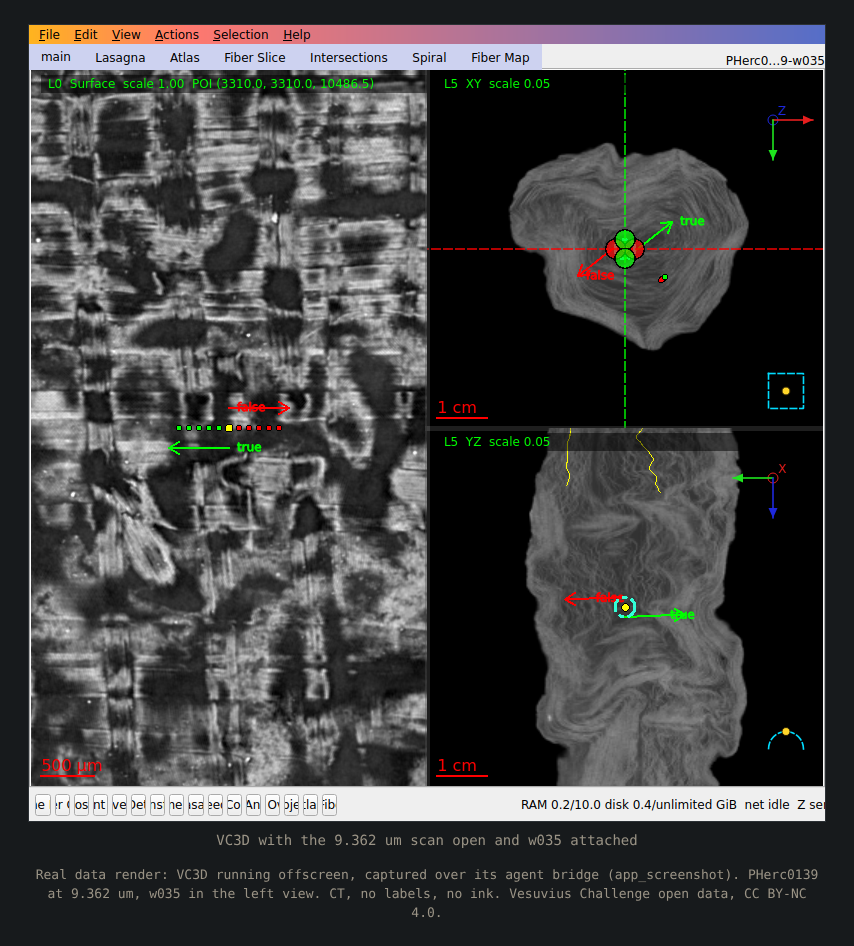

- ViewersUmbiliciEvery known public center line for 35 scans, 91 lines from seven sources, drawn in 3D over the CT.
- SurfacesRingleaderLabels every sheet pixel of a z-slice with its winding in one convex solve, scored against hand windings with controls.
- PipelineAutoPipeline 0.1.11Runs villa’s VC3D tools and ink detection on a released scan, from surface checks to ink maps scored with controls.
- SurfacesPartingWhere two papyrus layers touch, scores whether a point is on the same layer or the next.
- ViewersVesuvius RadarNew papers, code, models and data that could help read the scrolls, collected from public sources around the clock.
- SurfacesLasagnettaA fast preview of villa’s lasagna field, 5.2 times faster than villa predict3d end to end, with a self-check against villa.
- ViewersInk AtlasSeven public ink models on the same First Letters surfaces, side by side on one 9.6 µm canvas.
- DataAFV Fibers23.2 million papyrus fiber curves from Qual’s AFV V2 for six whole scans, as files VC3D opens.
- SurfacesSnapped LabelsEvery published surface label of four scrolls, moved onto the papyrus recto face, with a viewer on live CT.
- InkCrackle CheckAsks one ink model whether a small patch shows ink crackle, with the reversed layer order as its control.
- ChecksFiber CheckerA free per-patch map of whether papyrus fibers are visible on a traced surface, with a self-check on every run.
- DataLasagna FieldsWhole-scan lasagna fields for 24 scrolls, with a Space to find them or make a new one.
- InkInk LensChecks one region of a VC3D segment for ink in seconds, keeping only ink above its own reversed-depth control.
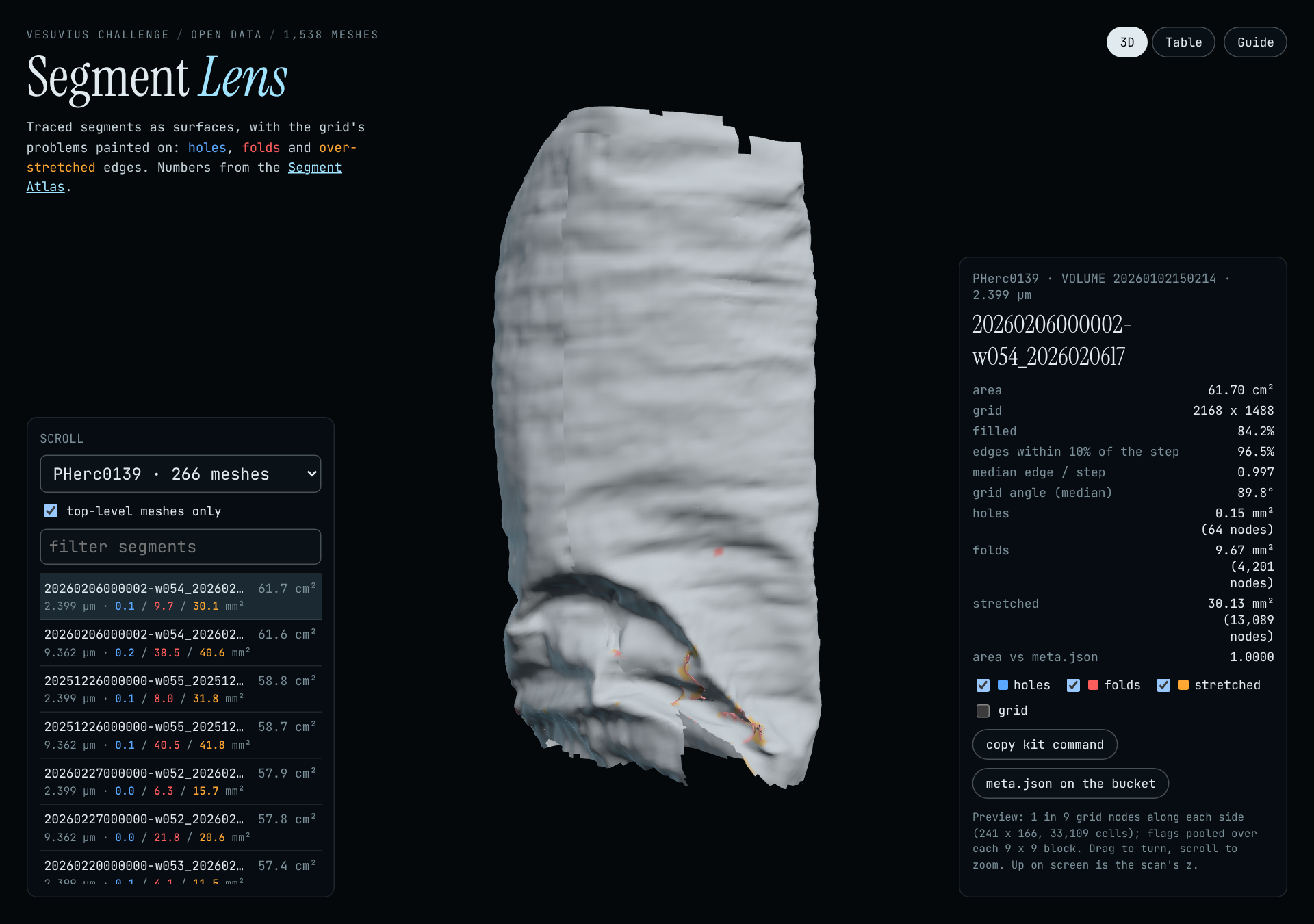
- ViewersSegment LensPublished segment meshes with geometry warnings and the Segment Atlas table.
- PipelineHeadless VC3DAn MCP server and shell command that let an AI agent run villa’s VC3D tools with no display.
- Datadinovol embeddingsThe whole PHerc0841 scan run through the organizers’ dinovol model, to search and cluster without a GPU.
- ViewersScroll LensWhat the organizers’ 3D models see inside a cube of a public scan.
- InkInkfilterModel-free maps from a surface-volume window, each with a reversed-depth control. Not a trained reader.
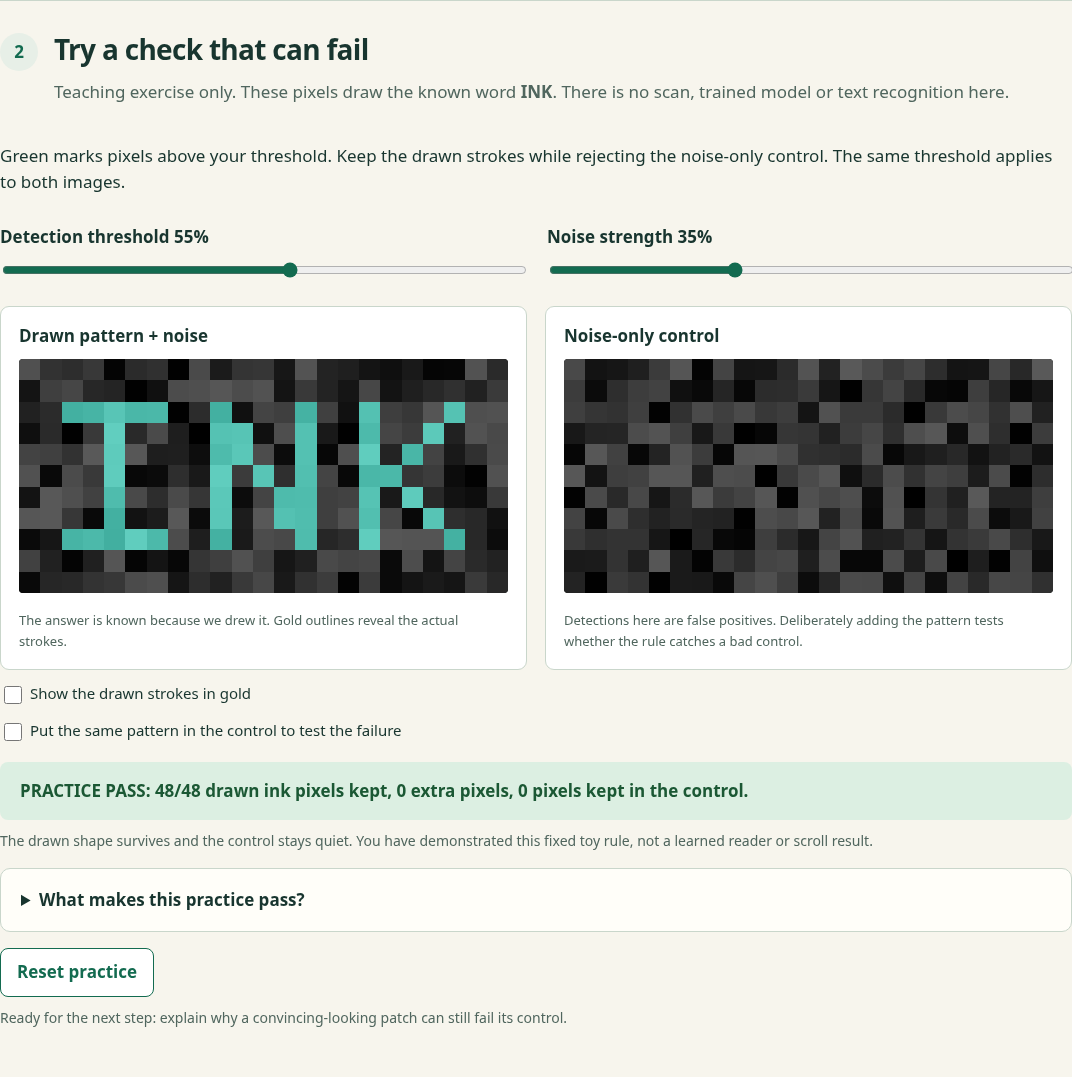
- PipelineScrolls StarterA beginner path in the browser: a synthetic exercise with a control, a setup checker and a command builder.
- ViewersUnrollVirtually unrolls scroll scans in 3D in the browser, with ink layers, CT tools and an Ink Bench.
Field guide and first stepsWhat each tool needsSource on GitHub
2Papers
Computer-assisted proofs: every inequality is decided in interval or ball arithmetic, and the programs ship with the paper. These are preprints and have not been peer reviewed.
- 01
Fluid dynamics
Minimal Winding in the Self-Similar Collapse of Point Vortices
Sharp winding bounds and computer-assisted results for collapsing vortex configurations.
- 02
Fluid dynamics
Point-Vortex Collapse Without Rotation: A Cluster Mechanism, a Phase Diagram and a Continuum Limit
Cluster mechanisms and numerical phase diagrams for vortex collapse without rotation.
- 03
Fluid dynamics
Stable Self-Similar Expansion of Four and Five Point Vortices and Confinement of Vortex Patches
Computer-assisted configurations, nonlinear stability, and confinement estimates.
- 04
Neuroscience
A Finite Rank Window Cannot Show That a Neural Population Code Satisfies the Eigenspectrum Smoothness Bound
The limits of inferring asymptotic smoothness from finite neural eigenspectra.
- 05
Neuroscience
Hopf Bifurcations and Bistability in the Hodgkin-Huxley Equations at the 1952 Parameters: Computer-Assisted Proofs
Computer-assisted analysis of equilibrium stability and bistability in the classical model.
- 06
Dynamical systems
Chaos and Analytic Non-Integrability of the Classical Double Pendulum: A Computer-Assisted Proof
Interval arithmetic proofs for chaotic dynamics at specified energies.
- 07
Neuroscience
Traveling Pulses in a Neural Field with a Smooth Firing Rate: Computer-Assisted Existence and Spectral Stability
Computer-assisted pulse existence and spectral stability in neural field models.
- 08
Neuroscience
The Propagated Action Potential of Hodgkin and Huxley at Their 1952 Constants: A Computer-Assisted Existence Proof
A computer-assisted existence proof for the propagated action potential at two temperatures.
- 09
Cardiac electrophysiology
Stable Rotating Waves in Rings of a Modified Ventricular Cell Model: Computer-Assisted Proofs
Computer-assisted proofs of stable rotating waves in rings of a ventricular cell model.
- 10
Cryptography
Excluding Classical Cipher Families for the 1939 D'Agapeyeff Challenge: Key-Free Counts and Searches with Demonstrated Power
Which classical cipher families the 1939 D’Agapeyeff challenge excludes, by key-free counts and by searches with demonstrated power. No reading is claimed.
3Other projects
Smaller things, some finished, some not.
- GENChaseA private simulation workspace. The public catalog lists its 135 techniques with sample renders.
- Cipher LabNotes and a browser engine for unsolved ciphers. No recovered plaintext is claimed.
- Oro and MPC StudioOro is a 3D wave terrain synthesizer that plays in the browser. MPC Studio makes ambient soundscapes for Akai MPC.
- Generative artPictures made with scientific models: growth patterns, tilings, waves, fields and artificial life.
- Fibers of EarthAn atlas of textile materials, their histories and their science.
- SaveDeskA searchable library for X likes and bookmarks.
- PageArmEdit and update the scripts in everyday web pages.
- ThermalPilotFan control and live telemetry for macOS.
4About
Hendrick Research is the independent practice of Chase Hendrick. The software is written with AI-assisted programming. Chase sets the questions and the methods and checks the results before anything goes out. Each release says what was tested and what was not.
Corrections are welcome. The quickest route is an issue on GitHub.